
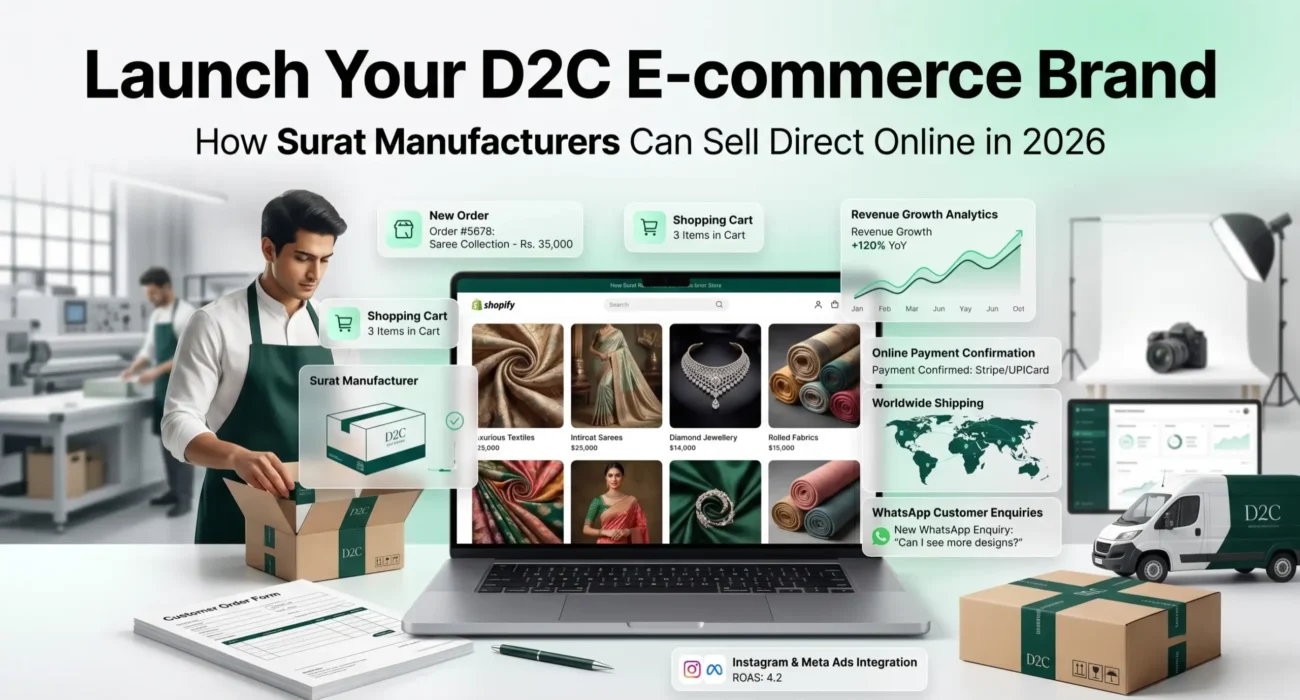
Surat manufacturers supply the world. Fabrics go to fashion labels in Mumbai. Diamonds go to jewellers in Antwerp. Sarees go to boutiques in London. Chemical products go to industries across Asia.
But here is what most Surat manufacturers never see: the margin their products earn after they leave their hands.
A fabric you sell at ₹200 per metre lands on a retail customer’s table at ₹800. A diamond you polish and export for ₹50,000 is retailed for ₹1,50,000+. A saree you manufacture for ₹1,500 is sold by a boutique for ₹6,000.
The difference 3x to 5x — goes to traders, distributors, retailers, and marketplaces. Not to you.
D2C e-commerce (Direct-to-Consumer) changes this equation permanently.
This is the complete guide for Surat manufacturers who are ready to launch their own online store and start capturing the full value of what they make.
What Is D2C E-commerce and Why Does It Matter for Surat Manufacturers?
D2C — Direct-to-Consumer — means selling your products directly to the end buyer through your own website or app, without distributors, retailers, or marketplace intermediaries taking a cut.
For Surat manufacturers, D2C e-commerce means:
- Higher margins: Selling at 2–5x your current B2B price, direct to retail customers
- Brand ownership: Building a brand that customers recognise and return to, rather than being a nameless supplier
- Customer data: Knowing exactly who your customers are, what they buy, and when data that is currently owned by your retailers and marketplaces
- Geographic expansion: Selling to customers in Mumbai, Delhi, Bengaluru, and NRI markets in the UK, USA, and UAE without a distribution network
- Reduced dependency: Not being at the mercy of a handful of B2B buyers who control your pricing and payment terms
The Surat businesses that go D2C in 2026 will be building assets — brands, customer lists, repeat purchase systems — that compound in value year after year.
Step 1: Decide What You Will Sell D2C and to Whom
Not everything you manufacture is equally suited to D2C e-commerce. Before building anything, answer these questions:
Who is your end consumer? Is it an individual retail customer (B2C), a small business owner (B2B), or both? Your platform choice, pricing strategy, and marketing will differ significantly.
What is the minimum viable product for D2C? You do not need to put your entire catalogue online. Start with your 10–20 bestselling or highest-margin products, with professional photography and detailed descriptions.
What is your price point? Products priced below ₹500 are difficult to make profitable D2C due to shipping and customer acquisition costs. Products priced ₹1,000–₹10,000 have the strongest D2C unit economics for most Surat manufacturers.
Can you handle individual orders? B2B manufacturing is optimised for bulk orders. D2C means individual customers ordering 1–5 pieces at a time. You need fulfilment processes for individual packaging, shipping, and returns before you launch.
Step 2: Choose Your E-commerce Platform
For most Surat manufacturers launching D2C in 2026, the platform decision comes down to three options:
Shopify (Recommended for most businesses)
Shopify is the gold standard for D2C e-commerce globally and in India. It is reliable, fast, beautifully designed, and integrates with every Indian payment gateway (Razorpay, PayU, CCAvenue), shipping partner (Shiprocket, Delhivery, BlueDart), and marketing tool.
Best for: Fashion, jewellery, sarees, home goods, cosmetics, gift products — any product with strong visual appeal and a retail consumer buyer.
Cost: Plans start at approximately ₹2,000/month. Add ₹20,000–50,000 for professional development and setup.
WooCommerce (Best for WordPress users with custom needs)
WooCommerce is a free plugin that turns any WordPress website into an e-commerce store. It is highly customisable and more affordable, but requires more technical management than Shopify.
Best for: Businesses that already have a WordPress website, need heavy customisation, or are in B2B categories with complex pricing structures (e.g., wholesale pricing tiers).
Amazon / Flipkart / Meesho (Marketplace — Not recommended as primary channel)
Marketplaces give you access to existing traffic but at a steep cost: 15–30% commission, price wars, no customer data, no brand building, and complete dependency on the platform’s algorithm.
Use marketplaces to supplement your D2C store, not replace it. Your own Shopify website is the foundation; marketplaces are additional distribution.
Step 3: Product Photography — Your Single Biggest Investment
In e-commerce, your photography IS your product. A customer cannot touch your fabric or try on your jewellery the images must do that work.
For Surat manufacturers transitioning to D2C, professional product photography is the single highest-ROI investment you will make. Poor photography is the number one reason D2C stores fail not the product, not the website, not the marketing.
What professional D2C photography requires:
For textile/saree businesses: Lifestyle shots (a model wearing the saree in a relatable, aspirational setting), close-up detail shots showing texture and embroidery, flat-lay shots for catalogue browsing, and a white background product shot for clean listings.
For jewellery businesses: Macro shots showing craftsmanship detail, model/lifestyle shots showing the piece being worn, 360-degree product videos, and white background shots for catalogue use.
For other products: Always include multiple angles, a size/scale reference, detail shots, and a lifestyle context image.
Budget ₹15,000–40,000 for a proper product photography session for your launch catalogue. This investment will pay back within the first month of sales.
Step 4: Build Your Shopify Store for Conversion
A D2C store is not just a digital catalogue, it is a sales machine that must convince a stranger to trust you with their money in under 3 minutes.
Homepage: A strong hero image or video, your brand value proposition (“Straight from Surat’s Looms to Your Wardrobe”), a featured collection, social proof (reviews, press mentions), and a clear CTA.
Product Pages: This is where buying decisions are made. Each product page must have: multiple high-quality images, a detailed description that sells the product’s story (not just specifications), size guides and fabric information, genuine customer reviews, clear delivery timeline and return policy, and a prominent “Add to Cart” / “Buy Now” button.
Trust Elements: Display your GST number, return policy, secure payment badges, and customer reviews prominently. First-time buyers from outside Surat are taking a trust leap — remove every possible doubt.
Indian Checkout Optimisation: Enable UPI (Google Pay, PhonePe, Paytm), EMI options for higher-ticket items, Cash on Delivery (COD) for customers who are hesitant — COD typically represents 40–60% of first-time orders from Indian D2C stores.
Step 5: Set Up Logistics and Fulfilment
Before you take a single order, your fulfilment system must be ready.
Shipping partners: For pan-India D2C shipping, integrate with Shiprocket (aggregates multiple carriers: BlueDart, Delhivery, DTDC, Ekart). Shiprocket provides a single dashboard to manage all shipments, track orders, and handle returns.
Packaging: Your packaging is a brand touchpoint. A customer in Delhi receiving a Surat saree in a branded box with a handwritten thank-you card has an experience that generates word-of-mouth, social sharing, and repeat purchases. Budget ₹20–50 per order for branded packaging.
Returns policy: A clear, generous returns policy dramatically improves conversion rates. For fashion and jewellery D2C, a 7–15 day return window is standard. The fear of a difficult return process stops many first-time buyers.
GST compliance: Ensure you are registered for GST and that your Shopify store is configured correctly for GST-inclusive pricing, e-invoicing, and interstate tax compliance. This is non-negotiable for D2C businesses in India.
Step 6: Drive Traffic to Your New D2C Store
Building the store is the foundation. Getting buyers to it requires a multi-channel marketing strategy.
Instagram & Reels: For visual products like sarees, jewellery, and fashion, Instagram is the primary D2C customer acquisition channel. Post product Reels, lifestyle content, and behind-the-scenes videos consistently. Link your Shopify store in your bio and use Instagram Shopping tags.
Meta Ads (Facebook & Instagram): Once you have 30–50 orders and some product photography, launch targeted Meta Ads. Start with catalogue ads (showing your products to people who have shown interest in similar items) and retargeting ads (re-engaging website visitors who did not purchase). Initial budget: ₹5,000–10,000 per month to test and learn.
Google Shopping Ads: For products with high search intent (“buy Surat saree online,” “Surat diamond pendant”), Google Shopping ads show your product image and price at the top of search results. These are high-intent buyers who are actively looking to purchase.
WhatsApp Marketing: Build your opted-in WhatsApp list from day one. Announce new collections, send abandoned cart reminders, and build a VIP customer segment with early access to new drops.
SEO: Optimise your Shopify product pages and blog for search terms your customers use. A blog post on “How to Choose the Perfect Surat Silk Saree” that ranks on Google drives consistent free traffic to your store for years.
Step 7: Retain Customers and Build Repeat Revenue
Acquiring a new D2C customer costs 5–7x more than retaining an existing one. Your post-purchase strategy determines whether your D2C business is profitable in the long run.
Email marketing: Set up automated email flows for new customers: welcome series, post-purchase thank you, review request at day 7, replenishment reminder at day 30, and loyalty offer at day 60. Klaviyo and Mailchimp both integrate with Shopify.
Loyalty programme: A simple points-based programme (earn 1 point per ₹100 spent, redeem for discounts) increases repeat purchase rate significantly. Shopify has several loyalty app integrations available.
WhatsApp retention broadcasts: Your existing customer list is your most valuable asset. New collection announcements, festival offers, and exclusive early access sent via WhatsApp to your customer list consistently drive 20–30% of monthly revenue for mature D2C brands.
The Surat Manufacturer’s D2C Launch Timeline
Month 1: Platform setup, product photography, logistics integration, payment gateway configuration, first 20 products live.
Month 2: Launch on Instagram, first Meta Ads campaign, WhatsApp list building begins, first 30–50 orders.
Month 3: Analyse what’s working, optimise product pages based on data, scale ad budget on winning products, launch email marketing flows.
Month 6: First 200+ orders, brand recognition building, expand catalogue, explore Google Shopping Ads.
Year 1: Established D2C channel contributing 30–50% of total revenue at significantly higher margins than B2B.
Ready to Launch Your Surat Manufacturing Business D2C?
The opportunity is enormous. Your product is world-class. What you need is the digital infrastructure and marketing system to connect it directly with the customers who will pay full price for it.
At Softrica, we help Surat manufacturers build complete D2C e-commerce ecosystems — from Shopify development to Meta Ads to WhatsApp marketing — all under one roof.
📞 Call: +91 91043 19997
📧 Email:
contact@softrica.com
info@softrica.com
🌐 Get a Free Website Conversion Audit →