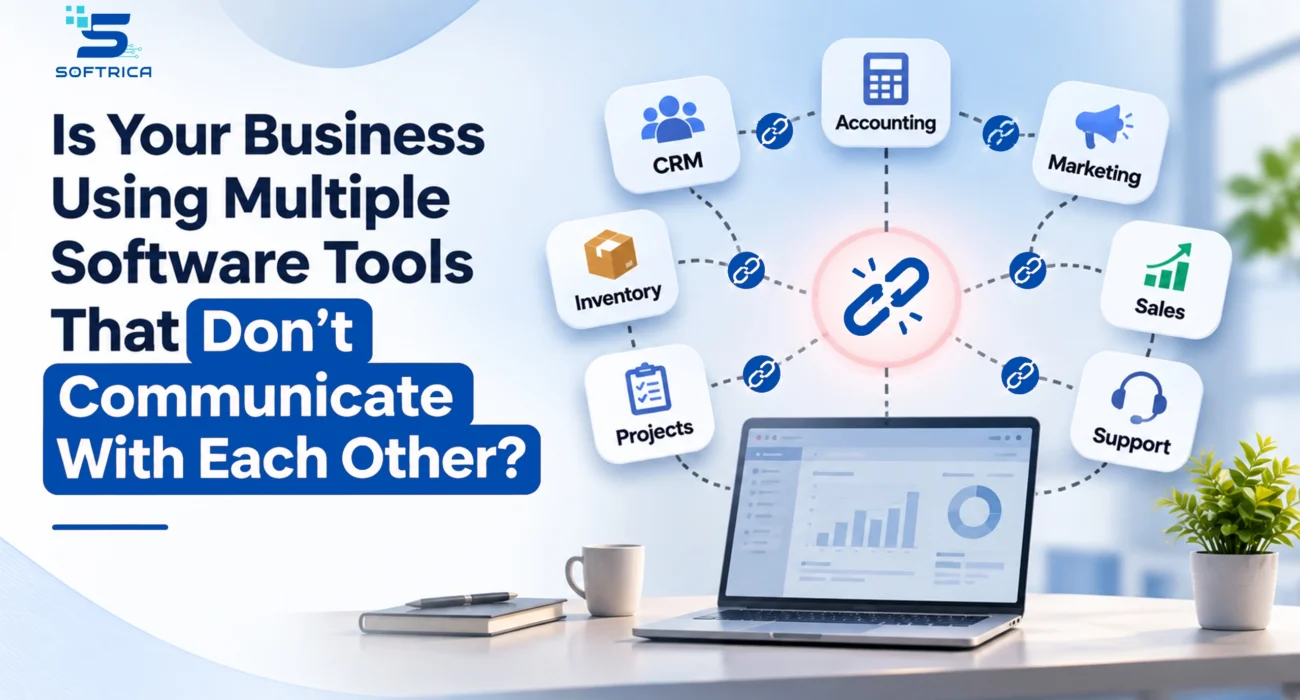
Your marketing team uses one platform; your sales team manages leads elsewhere; your accounts team uses separate software; and customer information is stored across multiple systems. Sound familiar?
Using multiple software tools is common in modern businesses. The real problem begins when these tools cannot communicate with each other. Instead of simplifying operations, technology starts creating additional work.
For growing businesses, software integration is no longer just a technical requirement. It is an important part of operational efficiency and digital transformation.
The Hidden Problem With Disconnected Business Software
Imagine a customer submits an enquiry through your website. Your marketing team receives the lead, but the sales team has to enter the details manually into its CRM. Later, the accounts department updates payment information in another system.
This creates unnecessary steps and increases the possibility of errors.
Some common challenges include:
- Repeated Data Entry: Employees enter the same information into multiple platforms.
- Delayed Communication: Teams may not receive updated customer or business information on time.
- Limited Visibility: Business owners struggle to get a complete picture of operations.
- Human Errors: Manual transfers increase the chances of incorrect or missing information.
- Lost Productivity: Employees spend more time managing software than completing meaningful work.
Over time, these small inefficiencies can affect customer experience and business performance.
Why Business Software Integration Matters
Integrated business systems allow different applications to exchange information automatically.
For example, your website can send enquiries directly to your CRM. Your CRM can connect with your email marketing platform, while relevant sales information can flow into your reporting system.
This creates a connected workflow where information moves between departments without unnecessary manual involvement.
The benefits include:
- Better Operational Efficiency: Automate repetitive tasks and reduce manual data handling.
- Improved Data Accuracy: Maintain consistent information across connected platforms.
- Faster Decision-Making: Access more reliable business information through centralized reporting.
- Better Customer Experience: Help teams respond faster with updated customer information.
How Can Your Business Build a Connected Software Ecosystem?
Start by identifying the software your teams currently use and understanding where information gets stuck.
Next, identify platforms that need to exchange data. Depending on your requirements, integration can happen through APIs, automation platforms, middleware, or custom software development.
Avoid connecting every tool without a clear purpose. Focus on workflows that save time, improve accuracy, and support business growth.
Make Your Business Technology Work Together With Softrica
Technology should simplify business operations, not complicate them.
At Softrica Innovation, we help businesses move beyond disconnected digital tools through IT solutions, website development, business automation and digital transformation strategies.
Whether you need custom software integration, connected business systems or a more efficient digital infrastructure, our team can help build solutions around your business requirements.
Let’s make your technology work as one connected system.
Connect with Softrica Innovation:
Website: https://www.softrica.com/
Email: contact@softrica.com
Phone: +91 91043 19997
FAQs
-
What is business software integration?
Business software integration connects different applications so they can exchange information and work together without repeated manual data entry.
-
Why do businesses need integrated software systems?
Integration helps reduce operational delays, improve data accuracy, automate workflows and give teams better access to business information.
-
Can different software platforms be connected?
Yes. Many platforms can be connected through APIs, middleware, automation tools or custom software development, depending on their technical capabilities.
-
How can software integration support digital transformation?
It creates connected workflows, improves collaboration between departments and helps businesses use technology more effectively as they grow.