Your business software may be old, but that doesn’t automatically mean it needs to be replaced.
Many companies still depend on software built years ago. It may run critical operations, store valuable business data, or support processes employees understand well. The problem begins when the system becomes difficult to maintain, integrate, secure, or scale.
The common reaction is:
“We need to rebuild everything.”
But a complete rebuild isn’t always necessary.
A well-planned legacy software modernization strategy can help businesses improve existing systems gradually while continuing to use the technology that already works.
Why Do Businesses Modernize Legacy Software?
Older applications can create several challenges:
- Difficult maintenance
- Outdated technology stacks
- Poor integration with modern tools
- Slow performance
- Security concerns
- Limited scalability
- Manual processes
- Difficulty supporting new customer expectations
However, legacy systems often contain years of business logic and valuable data. Replacing everything at once can introduce significant cost, disruption, and implementation risk.
That’s why application modernization often focuses on improving the existing system rather than immediately replacing it.
1. Start With a Technology Audit
Before changing anything, understand what you already have.
Identify the application’s architecture, dependencies, databases, integrations, security risks, performance issues, and business-critical functions.
This helps determine which components need immediate attention and which can continue operating.
2. Modernize in Modules
You don’t have to change the entire application at once.
A business might modernize one component while keeping the core system running.
For example:
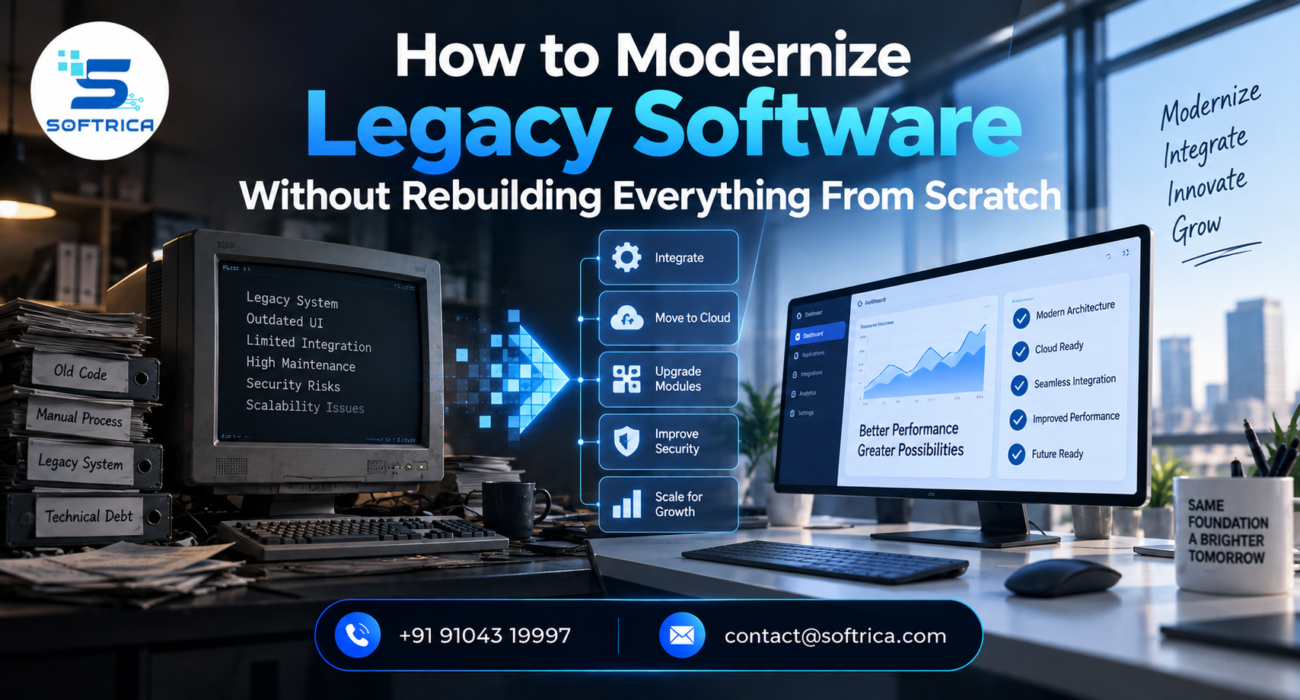
Legacy System → API Layer → Modern Application → Cloud Services
This approach allows new technology to communicate with existing systems without requiring an immediate complete rebuild.
3. Introduce APIs and Integrations
Legacy software often struggles to communicate with modern CRM platforms, payment systems, analytics tools, mobile applications, or other business software.
APIs can create a connection between old and new systems, making integration possible while reducing the need to rewrite the entire application.
4. Move Suitable Components to the Cloud
Cloud migration doesn’t necessarily mean moving everything immediately.
Businesses can evaluate which workloads, databases, services, or applications can benefit from cloud infrastructure while keeping other components where they are.
A gradual approach can make legacy system modernization more manageable.
5. Automate Manual Workflows
Modernization isn’t only about technology architecture.
If employees still manually transfer data between systems, generate reports, or process repetitive tasks, automation can create immediate operational improvements.
AI and workflow automation can also be introduced where they provide measurable business value.
A Practical Modernization Strategy
The right approach is usually:
Audit → Prioritize → Integrate → Modernize → Test → Measure → Scale
This reduces the pressure to replace everything at once and allows businesses to modernize according to actual priorities.
For businesses in Surat, Gujarat, and across India, modernization can be particularly valuable when existing software has become essential to daily operations but no longer supports the company’s growth plans.
Modernize With Softrica
At Softrica Innovation, software modernization is approached as part of a broader digital transformation strategy.
As a Digital Growth, Branding, IT & Digital Transformation Partner, Softrica can help businesses evaluate legacy applications and develop practical modernization roadmaps involving web applications, APIs, cloud technologies, automation, AI, integrations, databases, and scalable software systems.
The objective isn’t to rebuild technology simply because it’s old.
It’s to modernize what needs improvement while protecting the business value already built into the existing system.
FAQs
1. Does legacy software always need to be completely replaced?
No. Depending on its condition and business requirements, legacy software can often be modernized incrementally through APIs, integrations, cloud migration, modular redevelopment, and automation.
2. What is legacy software modernization?
Legacy software modernization is the process of improving older applications so they can better support modern security, integration, performance, scalability, and business requirements.
3. How can businesses modernize software without disrupting operations?
Businesses can use a phased approach, modernizing individual components while keeping critical legacy functionality operational. Proper testing and gradual migration can help reduce disruption.
4. How long does software modernization take?
The timeline depends on the application’s complexity, technology stack, integrations, data, and modernization goals. A technology audit is usually a useful first step for creating a realistic roadmap.