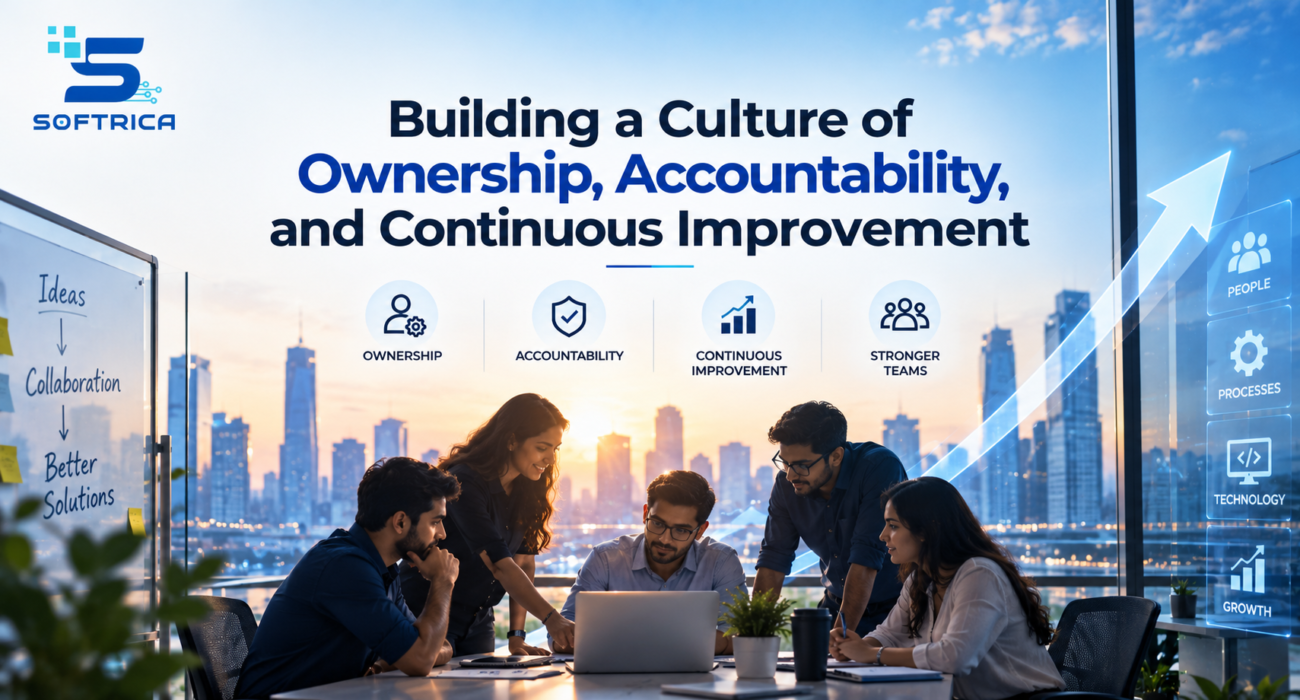
A growing company needs more than talented people and ambitious goals. It needs a way of working that helps everyone understand their responsibilities, collaborate effectively, and contribute to shared outcomes.
At Softrica, our long-term vision is to make technology easy and create meaningful growth for individuals and businesses. Building an organization capable of delivering that vision requires a strong foundation of people, processes, leadership, and continuous improvement.
Ownership Means Thinking Beyond Tasks
Completing a task is important, but understanding its purpose makes the work more meaningful.
Ownership means knowing what needs to be achieved, taking responsibility for the quality of the outcome, communicating progress, and identifying challenges before they become bigger problems.
For example, completing a software feature is only one part of delivering a useful solution. Understanding the requirement, considering the user experience, testing the result, documenting important details, and communicating progress all contribute to the final outcome.
When people understand how their work connects to a larger objective, they can make better decisions and contribute more effectively.
Accountability in the Workplace Creates Clarity
Accountability is often misunderstood as simply identifying who is responsible when something goes wrong.
In a healthy organization, accountability starts much earlier. It involves setting clear expectations, defining responsibilities, agreeing on deadlines, and making progress visible.
When everyone understands what they own, what success looks like, and when to communicate an issue, teams can coordinate their work with greater confidence.
Accountability should also include the support people need to succeed. Clear guidance, access to information, constructive feedback, and timely decisions help employees meet their responsibilities.
The objective is not to create unnecessary pressure. It is to build clarity and reliability into everyday work.
Strong Systems Support Strong Teams
As a company grows, informal communication alone can become difficult to manage.
Tasks may be discussed in different conversations. Decisions can be forgotten. Dependencies may go unnoticed. Management may struggle to understand the actual status of ongoing work.
Structured task management, shared documentation, clear communication channels, and regular progress reviews can help reduce these challenges.
These systems also make it easier to identify bottlenecks, improve coordination, and understand where teams need additional support.
We believe that a well-designed operating system should make work easier to understand and manage, rather than add unnecessary administrative complexity.
Feedback Should Lead to Improvement
No process is perfect from the beginning.
Projects reveal gaps. Customers raise new requirements. Teams discover more effective approaches. Technology introduces new possibilities.
A continuous improvement mindset encourages people to examine what worked, what did not, and what can be done better next time.
Constructive feedback is an important part of this process. It should be specific enough to guide improvement and timely enough to make a difference.
Recognition matters, too. Acknowledging good work reinforces positive practices and helps people understand the value of their contributions.
When feedback becomes part of everyday work, improvement becomes a shared responsibility rather than an occasional management exercise.
Leadership Must Build the Right Environment
Ownership and accountability cannot depend on employees alone.
Leadership has an important role in establishing clear priorities, providing the right resources, communicating expectations, and creating an environment where people can raise concerns and suggest improvements.
Managers also need to lead by example. If a company values accountability, its leaders must demonstrate it in their own decisions and commitments.
Likewise, if innovation is important, people need opportunities to experiment thoughtfully, learn from mistakes, and share ideas.
The culture of an organization is shaped not only by what it says, but also by what its systems and leaders consistently encourage.
Preparing for Sustainable Growth
As Softrica develops its capabilities across technology services, AI solutions, and software products, effective coordination and consistent execution become increasingly important.
New opportunities bring new responsibilities. Teams need to share knowledge, processes must evolve, and management systems need to support greater complexity.
Building these foundations helps an organization become less dependent on individual memory and more capable of delivering consistent outcomes.
It also creates opportunities for employees to develop leadership skills and take on greater responsibility as the company grows.
Progress Is Built Through Everyday Practices
A strong organizational culture does not emerge from a slogan or a single policy.
It develops through everyday decisions: communicating clearly, keeping commitments, documenting important information, giving useful feedback, and looking for better ways to work.
At Softrica, we believe accountability in the workplace starts with clear communication, shared responsibility, and a willingness to improve every day. By combining capable people, effective systems, supportive leadership, and continuous learning, organizations can build stronger teams and achieve consistent growth.
Our ambition is to keep learning as we grow, ensuring that people, processes, and technology work together to create meaningful value.
Softrica — Making Technology Easy. Enabling Growth.