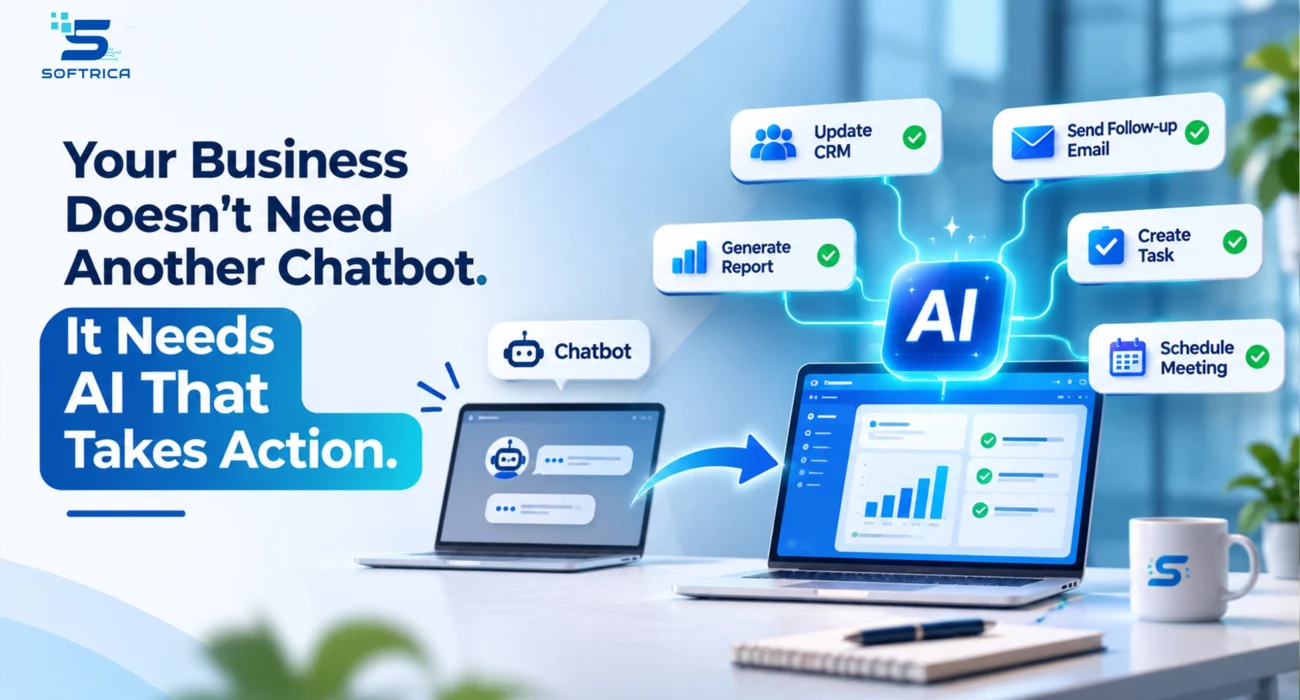
Your business probably doesn’t need another tool that simply answers questions. It needs technology that can actually get work done.
Imagine an AI system that doesn’t just respond to customer enquiries but also qualifies leads, updates your CRM, schedules appointments, sends follow-up messages, and helps your sales team move prospects forward. That’s where the real value of AI begins.
For businesses looking to grow, the next step isn’t adding more chatbots. It’s adopting AI automation that takes action.
The Problem: Most Business Chatbots Stop at Conversations
Many businesses have already experimented with AI chatbots on their websites, WhatsApp or social media platforms. While these tools can answer frequently asked questions and provide basic information, they often stop there.
A customer enquires, receives an automated response and then waits for a human employee to take the next step.
Meanwhile, teams continue handling repetitive activities manually:
- Entering customer details into CRM systems.
- Following up with potential customers.
- Managing appointment requests.
- Sending order updates and reminders.
- Moving information between different software platforms.
The result? More tools, but not necessarily better productivity.
What Makes Action-Based AI Different?
Traditional chatbots are designed primarily to communicate. AI agents and intelligent automation systems are designed to understand objectives, make decisions within defined rules, and execute tasks.
For example, when a potential customer submits an enquiry, an AI-powered workflow can:
- Understand the customer’s requirement.
- Identify and qualify the lead based on predefined criteria.
- Add customer information to the CRM.
- Assign the enquiry to the appropriate sales representative.
- Send a personalised follow-up message.
- Schedule another follow-up if there is no response.
Instead of simply answering a question, the system helps complete an entire business process.
Where Can Businesses Use AI That Takes Action?
The opportunities go beyond customer support.
Sales and Lead Management: Automatically capture, qualify, distribute and follow up with leads.
Customer Service: Handle common requests, retrieve relevant information and escalate complex issues to employees.
Marketing Operations: Connect campaign enquiries with CRM platforms, automate communication and organise customer data.
Internal Operations: Generate reports, manage approvals, process routine requests and connect multiple business applications.
For businesses in Surat and across India, these applications can reduce repetitive workloads and help teams focus on decisions that require human expertise.
How to Start Implementing AI Automation
Successful AI implementation doesn’t begin with buying multiple AI subscriptions. It begins with identifying the right business problem.
Start by identifying repetitive tasks that consume employee time. Map the existing workflow, determine which steps can be automated, and select suitable AI tools and integrations.
Set clear rules for approvals, data access, and human intervention. Finally, measure performance through time saved, response speed, operational costs and conversion improvements.
Build Smarter Business Operations with Softrica
AI should not become another disconnected tool in your business.
At Softrica Innovation, we help businesses bring technology, branding and digital growth together through intelligent IT solutions, custom software, workflow automation and digital transformation strategies.
Whether you want to automate lead management, connect existing software or build AI-powered business workflows, the focus should be on measurable business outcomes.
Your next competitive advantage may not come from having more AI tools. It may come from having AI that actually gets things done.
Ready to make AI work for your business? Connect with Softrica Innovation and explore smarter ways to automate, integrate, and grow.
Frequently Asked Questions:-
- What is the difference between an AI chatbot and an AI agent?
A chatbot primarily responds to user queries, while an AI agent can perform defined tasks, interact with connected systems and execute multi-step workflows.
- Can AI agents integrate with existing business software?
Yes. With suitable APIs and integrations, AI agents can connect with CRMs, websites, communication platforms and other business applications.
- Is AI automation suitable for small and medium businesses?
Yes. Businesses of different sizes can automate repetitive processes, improve customer response times and reduce manual workloads.
- Does AI automation replace employees?
Not necessarily. It can handle repetitive tasks while employees focus on customer relationships, strategic decisions and complex work.