Artificial Intelligence is no longer something businesses are simply curious about. Companies are testing AI tools, automating small tasks, and exploring new ways to improve productivity. Yet, despite all this experimentation, many businesses are still struggling to see meaningful results.
The problem isn’t that AI doesn’t work. The real problem is how businesses approach AI implementation.
The Problem: Experimentation Without a Clear Business Goal
Many businesses start their AI journey because a competitor is using it or because a new tool is trending. Teams experiment with chatbots, content generators and automation platforms without identifying what they actually want to improve.
As a result, AI remains an isolated activity rather than becoming part of everyday business operations.
A chatbot that doesn’t improve customer support or an automation tool that doesn’t save employees time adds little business value.
Why AI Experiments Fail to Deliver Results
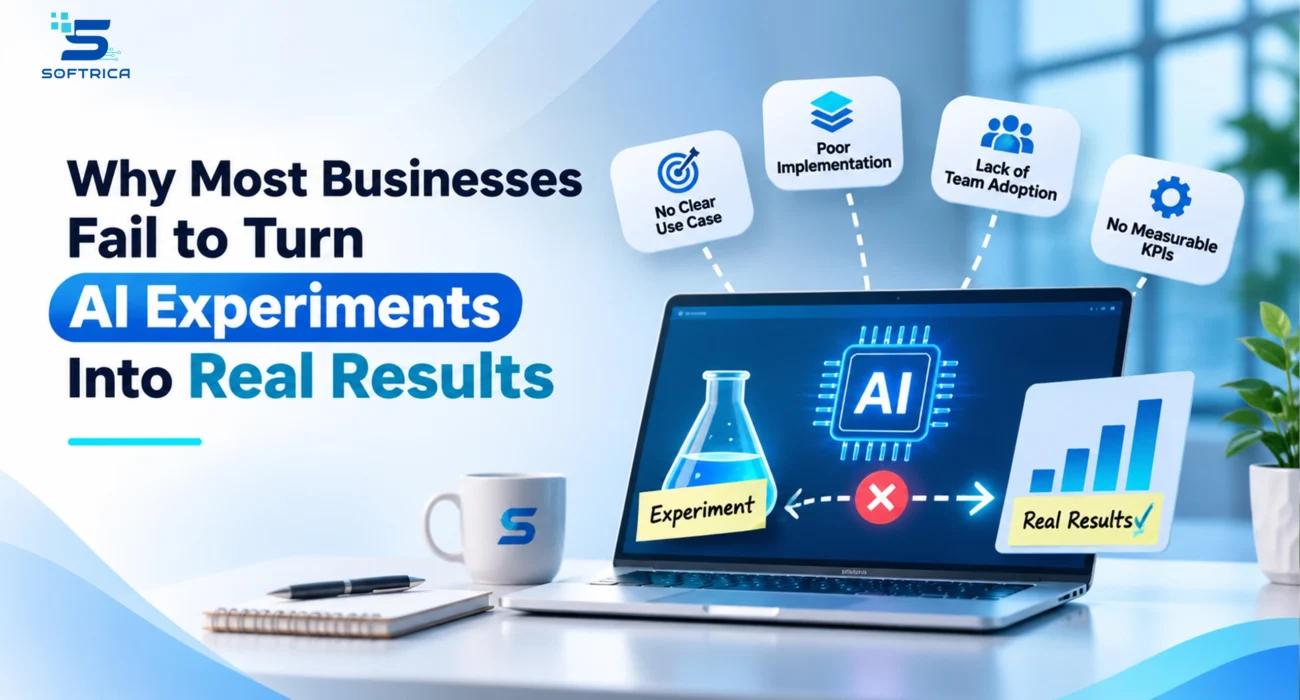
There are several reasons behind unsuccessful AI adoption.
- No defined business objective
Businesses often focus on what AI can do instead of identifying the problems it should solve. Without clear objectives, measuring success becomes difficult.
- Disconnected software and systems
AI tools need access to relevant business information. When CRM platforms, websites, sales systems and internal databases don’t communicate, automation becomes limited.
- Poor data quality
AI depends on reliable information. Incomplete, outdated or inconsistent business data can lead to inaccurate outputs and poor decisions.
- Lack of team involvement
Introducing AI without preparing employees creates resistance. Teams need to understand how these tools support their work rather than simply replace existing processes.
- No performance measurement
If businesses don’t track time saved, operational costs, lead response rates or conversion improvements, they cannot determine whether their AI investment is delivering value.
How to Turn AI Experiments Into Measurable Business Results
Successful AI implementation in business starts with strategy, not software.
Begin by identifying repetitive tasks, operational delays and customer experience gaps. Choose one high-impact problem and introduce AI to address it.
Next, connect AI solutions with existing business systems. Integrating CRM platforms, websites, marketing tools and internal workflows allows information to move efficiently across departments.
Establish measurable KPIs before implementation. These could include reduced response time, fewer manual tasks, improved lead management or lower operational costs.
Most importantly, involve your team and continuously improve the system based on actual performance.
Make AI Work for Your Business With Softrica
AI should do more than generate content or answer questions. It should help businesses operate smarter, respond faster, and make better decisions.
At Softrica Innovation, we help businesses move beyond experimentation through strategic technology integration, AI-powered automation, custom software solutions, digital transformation and growth-focused digital strategies.
Whether you want to automate workflows, connect disconnected systems or build smarter business processes, the first step is identifying where technology can create measurable value.
Stop experimenting with AI without direction. Start building an AI-powered business with Softrica Innovation.
Visit https://www.softrica.com/ to explore how we can help transform your business.
FAQs
- Why do businesses struggle with AI implementation?
Businesses often lack clear objectives, quality data, proper system integration and a defined strategy for measuring AI performance.
- How can businesses make AI more effective?
Start with specific operational challenges, select suitable AI solutions, integrate them with existing systems and measure results through KPIs.
- Is AI implementation suitable for small businesses?
Yes. Small businesses can use AI for customer support, lead management, marketing automation, reporting and repetitive administrative tasks.
- What is the difference between AI experimentation and AI implementation?
Experimentation involves testing AI tools. Implementation means integrating AI into actual business workflows to deliver measurable improvements.