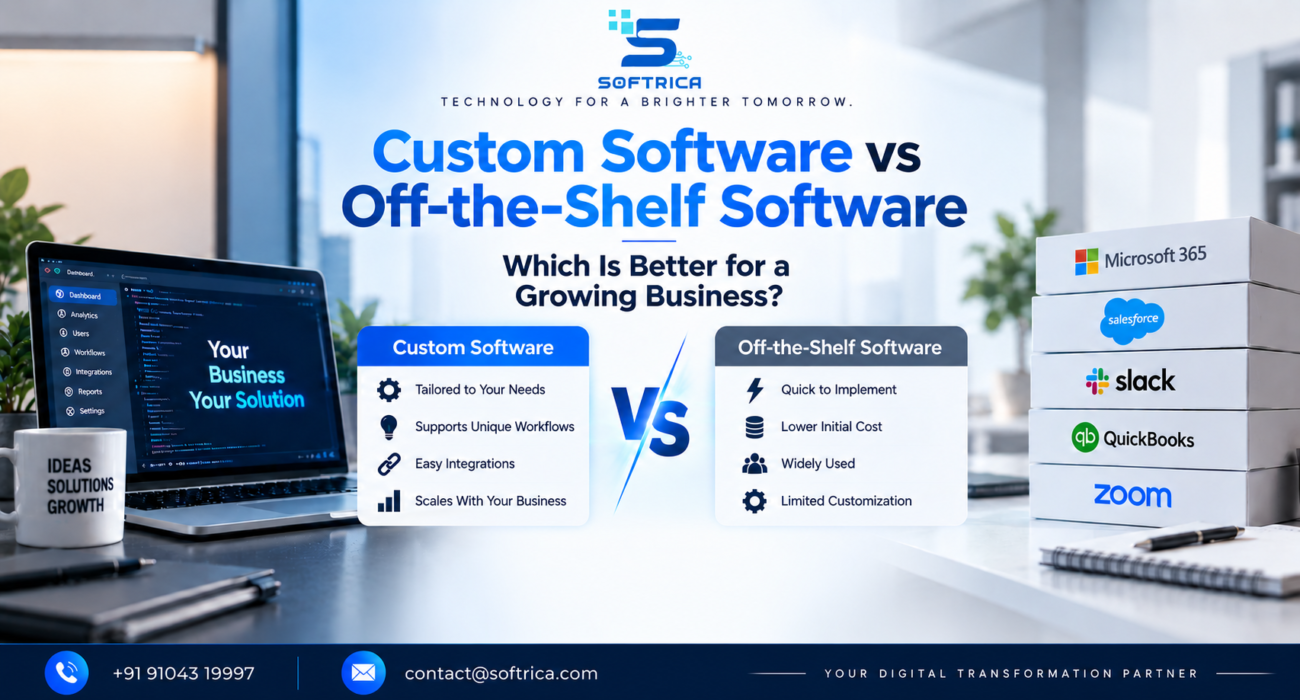
When a business starts growing, software decisions become more important. What worked for a small team may become inefficient when you have more employees, customers, transactions, and complex workflows.
That often leads to an important question:
Should you invest in custom software or choose an off-the-shelf solution?
There isn’t one answer for every business. The right choice depends on your processes, budget, scalability requirements, integrations, and long-term goals.
What Is Off-the-Shelf Software?
Off-the-shelf software is a ready-made product designed to serve a broad range of businesses.
Examples include accounting platforms, CRM systems, project management tools, HR software, communication platforms, and inventory systems.
The major advantage is speed. Businesses can generally subscribe, configure the software, train their team, and start using it without developing an entire application.
For businesses with standard processes, this can be practical.
However, limitations can appear as the business becomes more specialized.
Your team may have to change its workflow to match the software, pay for features it doesn’t use, or rely on additional tools to fill functionality gaps.
What Is Custom Software?
Custom software development involves creating software specifically around a company’s requirements.
Instead of adapting the business to an existing product, the technology is designed around the business.
Custom software can be built to support:
- Unique workflows
- Industry-specific processes
- Custom dashboards
- Business-specific automation
- CRM requirements
- Third-party integrations
- Specialized reporting
- Different user roles and permissions
This can make custom solutions particularly useful when standard software creates operational limitations.
Custom Software vs Off-the-Shelf Software: What Should You Consider?
1. Business Requirements
If your processes are fairly standard, off-the-shelf software may provide everything you need.
If your workflows are unique or complex, custom software may provide greater flexibility.
2. Budget
Off-the-shelf software generally requires a lower initial investment.
Custom development typically requires greater upfront investment because the solution must be planned, designed, developed, tested, and maintained.
3. Scalability
Growing businesses should consider what happens when their requirements change.
A scalable software solution should be able to accommodate additional users, workflows, data, integrations, and business requirements without becoming a major operational limitation.
4. Integrations
Modern businesses often use multiple systems.
If your CRM, ERP, website, payment gateway, inventory system, or internal tools need to communicate with each other, integration capabilities become an important consideration.
Sometimes the Best Answer Is a Hybrid Approach
You don’t necessarily need to build everything from scratch.
A business can use established platforms for standard functions while developing custom applications or integrations for areas where differentiation matters.
For example:
Existing CRM + Custom Application + APIs + Automation + Business Dashboard
This approach can provide flexibility without unnecessarily rebuilding standard functionality.
How Should a Growing Business Decide?
Before choosing software, ask:
Is the process standard or unique?
Do existing tools solve the problem effectively?
Will our requirements change significantly as we grow?
Do we need custom integrations or automation?
What is the total cost over several years—not just the initial price?
The goal isn’t to choose the most technically advanced option.
It’s to choose the technology that fits the business.
Build the Right Software Strategy With Softrica
At Softrica Innovation, software decisions are approached from a broader digital transformation perspective.
As a Digital Growth, Branding, IT & Digital Transformation Partner, Softrica helps businesses evaluate whether they need custom software development, existing platforms, integrations, automation, AI solutions, or a combination of technologies.
For businesses in Surat, Gujarat, and across India, the focus is on building practical and scalable software systems that support real business requirements.
The right software isn’t simply the one with the most features. It’s the one that helps your business work better and grow with confidence.
FAQs
1. Is custom software better than off-the-shelf software?
Neither is universally better. Off-the-shelf software can work well for standardized requirements, while custom software can be useful when a business needs unique workflows, integrations, or specialized functionality.
2. Is custom software more expensive?
Custom software generally requires a higher initial investment. However, businesses should compare the total long-term cost, including subscriptions, customization, integrations, maintenance, and operational inefficiencies.
3. When should a business consider custom software?
Consider custom development when existing solutions cannot efficiently support important business processes, integrations, scalability requirements, or specialized workflows.
4. Can a business combine custom and off-the-shelf software?
Yes. A hybrid approach can use ready-made platforms for standard functions while custom applications, APIs, and automation handle business-specific requirements.