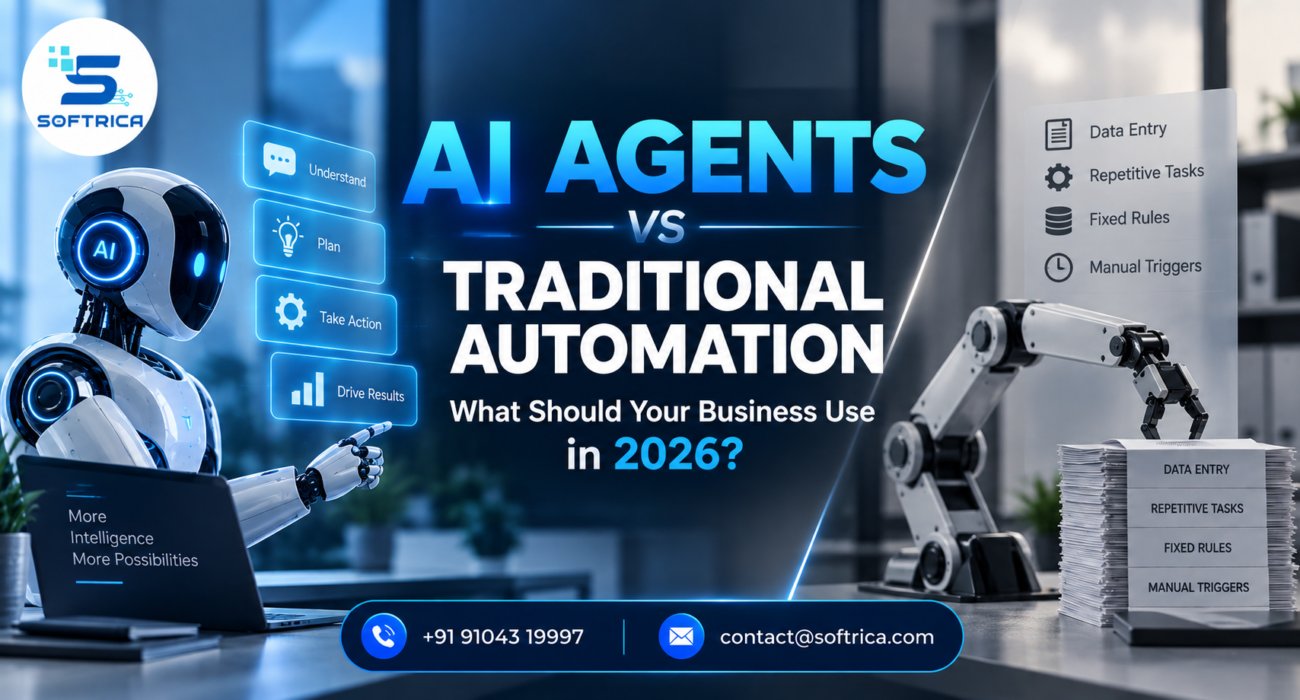
Automation has moved beyond simple “if this, then that” workflows. In 2026, businesses are asking a bigger question: Should we use traditional automation, AI agents, or both?
The answer isn’t about choosing the newest technology. It’s about understanding the type of work your business needs to automate.
For businesses in Surat, Gujarat, and growing companies across India, making the right choice can improve productivity, reduce repetitive work, and create more scalable operations.
Traditional Automation vs AI Agents: What’s the Difference?
Traditional automation works best when a process is predictable.
For example:
New lead arrives → Add to CRM → Assign salesperson → Send notification
The workflow follows predefined rules. When the conditions are clear, traditional automation can be reliable, fast, and cost-effective.
AI agents, on the other hand, are designed to handle tasks that may require understanding information, reasoning through options, using tools, and adapting their actions based on the situation.
For example, an AI agent could receive a customer enquiry, understand the request, check relevant information, prepare a response, update a CRM, and escalate the conversation when human assistance is needed.
When Should Your Business Use Traditional Automation?
Traditional business process automation is a strong choice when:
- The process follows fixed rules
- Inputs are predictable
- Decisions are straightforward
- Consistency is important
- The workflow rarely changes
Examples include invoice notifications, scheduled reports, lead assignment, data synchronization, reminders, and routine approvals.
There’s no reason to use AI where simple automation already solves the problem.
When Do AI Agents Make More Sense?
AI agents for business become useful when workflows involve unstructured information or multiple decisions.
They can support areas such as:
- Customer support
- Lead qualification
- Sales assistance
- Research
- Document analysis
- Internal knowledge management
- Data interpretation
- Multi-step business workflows
Instead of following only a fixed sequence, an agent can determine what action may be appropriate within defined permissions and guardrails.
The Best Approach May Be Both
Businesses don’t necessarily have to choose one technology.
A smarter AI business automation strategy can combine traditional automation with AI agents.
For example:
AI Agent → Understands Customer Request → Traditional Workflow → Updates CRM → AI Agent → Responds to Customer
This hybrid model can provide the flexibility of AI while keeping predictable processes controlled through established automation.
How Should You Choose in 2026?
Start with the process—not the technology.
Ask:
Is the workflow predictable?
Use traditional automation.
Does it require understanding, judgment, or handling variable information?
Consider an AI agent.
Does it contain both predictable and intelligent steps?
A hybrid approach may work best.
The objective should always be measurable business value: less manual work, faster response times, fewer errors, better customer experiences, and improved productivity.
Build the Right Automation Strategy With Softrica
At Softrica Innovation, automation is part of a broader digital transformation approach.
As a Digital Growth, Branding, IT & Digital Transformation Partner, Softrica can help businesses evaluate workflows and connect AI agents, traditional automation, CRM, applications, websites, analytics, and business systems into practical solutions.
Whether you’re a growing business in Surat or operating across multiple markets, the goal is not to automate everything. It’s to automate the right things, in the right way.