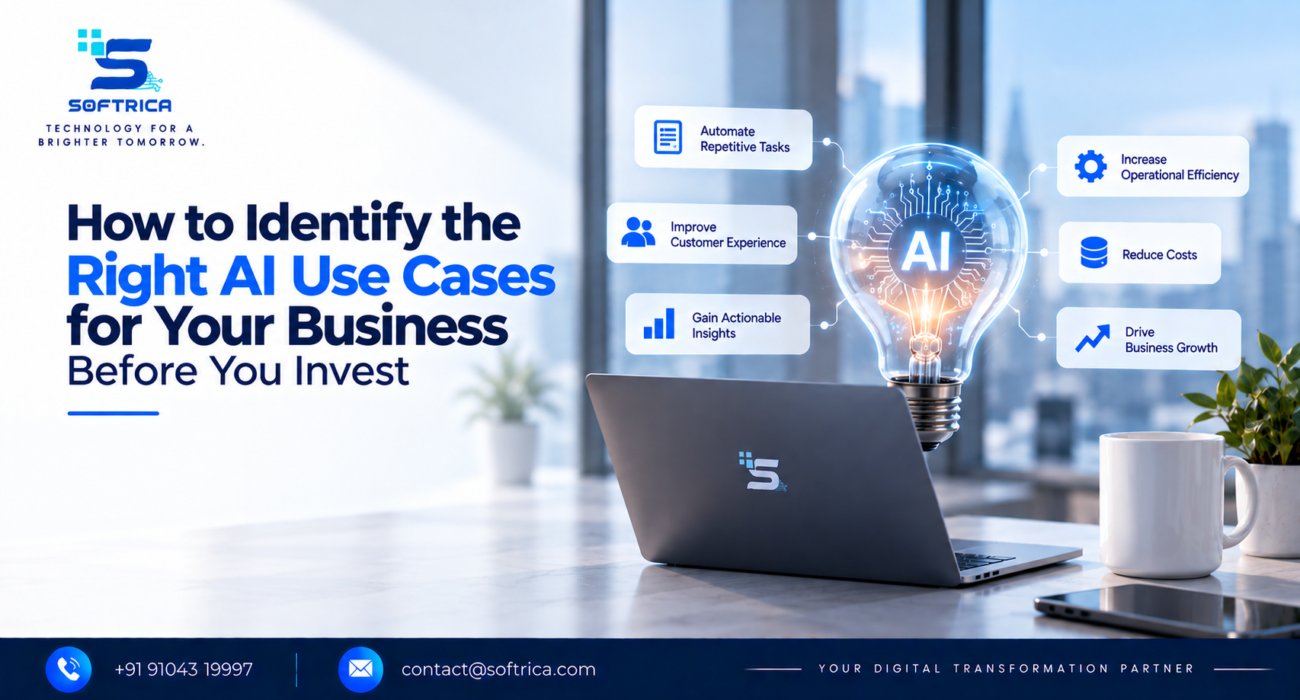
AI can automate tasks, improve decision-making, enhance customer experiences, and help businesses operate more efficiently. But that doesn’t mean every business process needs AI.
One of the biggest mistakes businesses make is investing in AI because it is trending rather than because it solves a specific problem. The better approach is to identify practical AI use cases for business first and then choose the right technology.
Start With Business Problems, Not AI Tools
Before asking, “Where can we use AI?”, ask:
“Which business problems are consuming the most time, money, or resources?”
Look for repetitive tasks, large amounts of data, slow response times, manual decision-making, frequent errors, or processes that require employees to perform the same work repeatedly.
For example, a business may discover opportunities in:
- Customer support queries
- Lead qualification
- Document processing
- Sales forecasting
- Internal reporting
- Data analysis
- Content workflows
- Inventory or demand prediction
These can become potential AI use cases rather than simply adding AI to existing systems without purpose.
Evaluate the Potential ROI
Not every AI opportunity deserves investment.
For each potential use case, consider:
Business Impact: How much time, cost, revenue, or efficiency could it influence?
Frequency: Does the process happen daily or only occasionally?
Data Availability: Does your business have enough reliable data for AI to work effectively?
Implementation Complexity: Can the solution integrate with your existing CRM, ERP, website, or other systems?
Human Oversight: Can employees review or manage AI-generated outputs where necessary?
A simple scoring framework can help your team compare opportunities based on impact, feasibility, cost, and risk.
Start Small Before Scaling
You don’t need to transform your entire business at once.
Choose one process where the potential value is clear and measurable. Build a pilot, track the results, identify limitations, and improve the workflow before expanding it.
For example, an AI customer-support assistant could initially handle frequently asked questions while complex issues continue to be handled by employees.
This approach allows businesses to validate an AI implementation strategy before making larger investments.
Build AI Around Your Existing Systems
The right AI solution should fit into your existing business operations.
Instead of creating another disconnected tool, businesses can connect AI with their CRM, ERP, website, customer-support platform, or internal databases through APIs and automation workflows.
This is where AI becomes part of business process automation rather than simply another software subscription.
How Softrica Can Help
At Softrica Innovation, we help businesses identify practical AI opportunities based on their workflows, operational challenges, existing technology, and growth objectives.
From AI automation and intelligent workflows to custom software and system integration, the focus is on building technology around measurable business needs.
Don’t start with AI. Start with the problem you want to solve.
FAQs
- How do I find AI use cases for my business?
Start by identifying repetitive, time-consuming, data-heavy, or error-prone processes where automation could create measurable value. - Should every business adopt AI?
AI can be useful, but the appropriate applications depend on the business model, processes, data, budget, and objectives. - Should I start with a large AI project?
A focused pilot can help validate value and implementation challenges before scaling. - Can AI integrate with existing business software?
Yes. Depending on the systems involved, APIs, automation platforms, and custom integrations can connect AI with existing business applications.