Running a growing business often means more than selling products or services. Teams spend hours every week updating spreadsheets, replying to routine enquiries, assigning leads, preparing reports, sending reminders, processing documents, and following up with customers.
The work gets done—but it consumes time.
And as the business grows, these small manual tasks can become a significant operational cost.
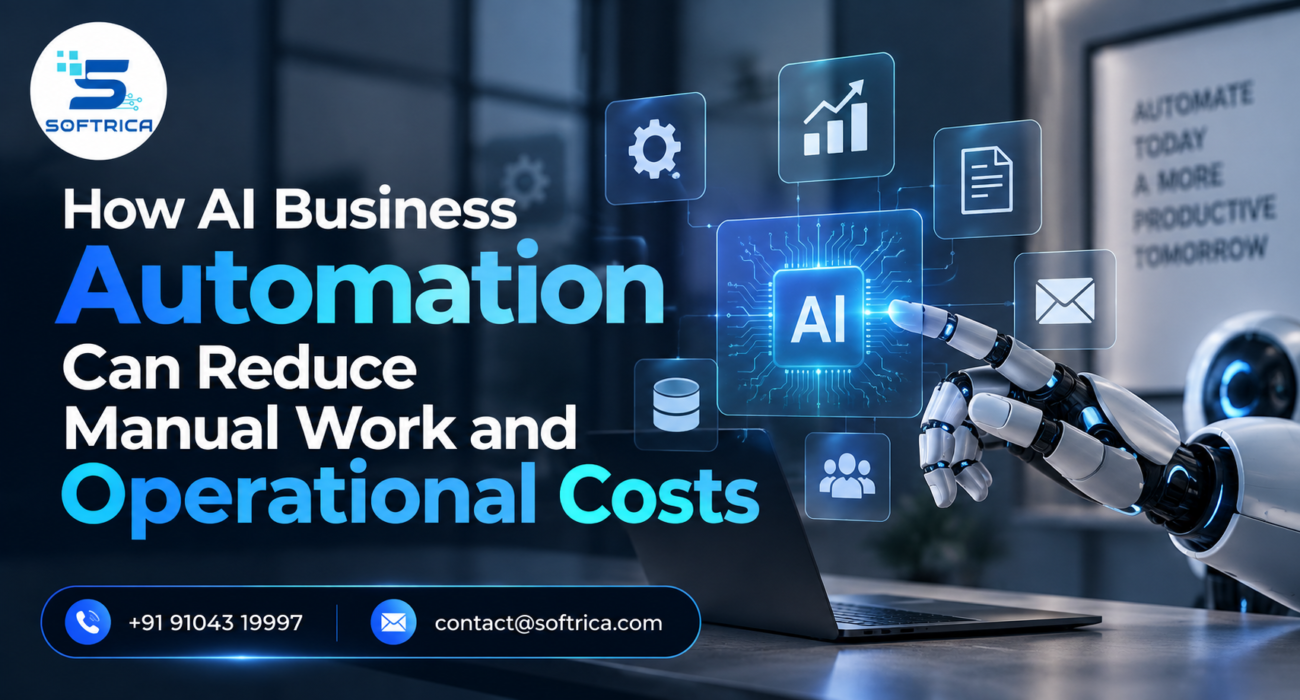
This is where AI business automation can make a practical difference.
What Is AI Business Automation?
AI business automation combines automation workflows with artificial intelligence to handle repetitive, rule-based, and data-driven processes with less manual intervention.
Traditional automation follows predefined rules.
AI-powered automation can go further by helping systems understand information, classify requests, generate responses, summarize data, identify patterns, and support decision-making.
The goal isn’t to replace every human task.
It’s to remove unnecessary manual work so people can focus on higher-value activities.
Where Can Businesses Use AI Automation?
1. Lead Management and Follow-Ups
When a new enquiry arrives, automation can capture the information, add it to a CRM, assign it to the right team member, and trigger follow-up communication.
AI can also help classify leads based on information provided by the customer.
2. Customer Support
Businesses receive many repetitive questions about pricing, availability, services, processes, and basic requirements.
AI-powered assistants can handle common queries instantly and route more complex conversations to the appropriate employee.
3. Reports and Data Processing
Employees often spend hours collecting information from different platforms and preparing reports.
AI automation can help organize data, summarize information, identify important changes, and prepare reports for management review.
4. Document and Administrative Work
Invoices, forms, emails, applications, and internal documents can create significant administrative workloads.
AI can assist with extracting information, categorizing documents, summarizing content, and moving information between connected systems.
How Does This Reduce Operational Costs?
The biggest benefit isn’t simply reducing the number of tasks employees perform.
It’s reducing the time and effort required to complete repetitive processes.
For example, if employees spend several hours every day on manual data entry and follow-ups, automating part of that workflow can free those hours for sales, customer relationships, strategy, and other productive activities.
Over time, better workflows can also reduce errors, improve response times, and create greater operational consistency.
AI Automation Should Start With the Right Processes
Not every process needs AI.
Businesses should first identify repetitive, time-consuming, high-volume workflows and evaluate where automation can create measurable value.
A practical approach is:
Identify → Analyse → Automate → Integrate → Measure → Optimise
The automation should connect with the tools the business already uses—such as CRM platforms, websites, communication systems, accounting software, or internal databases—rather than creating another disconnected system.
How Softrica Helps Businesses Automate
At Softrica Innovation, we look at automation from a broader business-growth perspective.
As a Digital Growth, Branding, IT & Digital Transformation Partner, Softrica can help businesses identify manual bottlenecks and build connected digital solutions involving AI, automation, CRM, websites, applications, analytics, and business systems.
The objective isn’t to automate for the sake of technology.
It’s to build systems that help businesses save time, improve productivity, control operational costs, and scale more efficiently.
Whether you’re a growing business in Surat, Gujarat, or serving customers across India and international markets, the right automation strategy can turn repetitive work into a more efficient digital workflow.
Want to identify where AI can reduce manual work in your business?
Contact Softrica Innovation at +91 91043 19997 or contact@softrica.com.
Suggested Internal Links
- AI & Automation Solutions
- IT Solutions for Businesses
- Digital Transformation Services
- Digital Marketing Services
- Technology Partner for Business Growth
- Softrica Blog
FAQs
1. What is AI business automation?
AI business automation uses artificial intelligence and automated workflows to reduce repetitive manual tasks such as data processing, customer support, lead management, reporting, and follow-ups.
2. Can AI automation reduce business costs?
Yes. By reducing the time employees spend on repetitive processes, businesses may improve productivity, reduce process inefficiencies, and handle growing workloads without increasing manual effort at the same rate.
3. Which business processes should be automated first?
Start with processes that are repetitive, high-volume, time-consuming, and clearly defined—such as lead routing, customer FAQs, data entry, reporting, reminders, and document processing.
4. Is AI automation suitable for small businesses?
Yes. Small businesses can begin with one or two high-impact workflows and expand automation as their needs grow. The focus should be on measurable business value rather than implementing AI everywhere.